PHP2Shell Update: Why Websites Went Offline and the New Third PHP Bug
CERT-In has rated PHP2Shell critical, European governments pulled sites offline, and PHP disclosed a third, unpatched bug on 23 October. Here's what changed and the one setting to add.
In this post7 sections
Here's the PHP2Shell update. Three days after PHP shipped emergency patches, India's CERT-In has issued a critical advisory, governments across Europe have taken their own websites offline as a precaution, and on 23 October PHP disclosed a third bug, CVE-2026-115560, which has no patch yet. If you run a website on PHP, or pay someone who does, you still have two jobs: update PHP, and add one line to your configuration.
PHP runs a huge share of the web, including WordPress, Drupal, Joomla and Magento sites. That's why a flaw in PHP itself, rather than in one app, has caused so much panic.
A quick recap of PHP2Shell
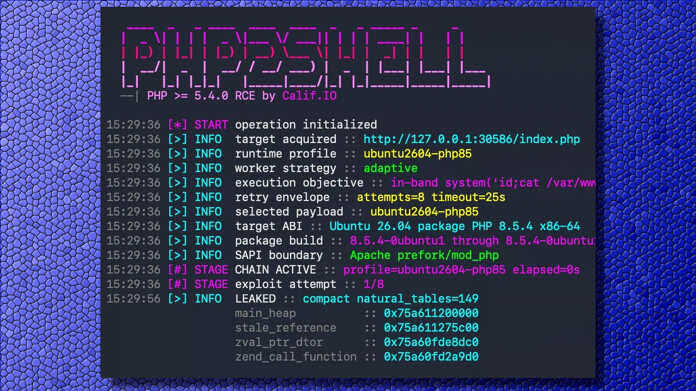
PHP2Shell is the nickname for two flaws, CVE-2026-109618 and CVE-2026-109619, each rated 9.2 out of 10 on the CVSS v4.0 severity scale. Both are remote code execution bugs: an attacker sends a specially crafted web request and can end up running their own commands on the server, without logging in.
According to PHP's official advisory, the CVE numbers leaked on 20 October, so PHP pulled its release forward by a day. The fixed versions came out on 21 October:
- PHP 8.5.12
- PHP 8.4.27
- PHP 8.3.36
- PHP 8.2.35 (8.2 stops getting security fixes on 31 December 2026)
- PHP 8.1 and older get no official updates, though PHP has published minimal source backports for 7.4, 8.0 and 8.1
PHP says every installation that serves web requests is at risk, including PHP-FPM, Apache with mod_php, php-cgi, FrankenPHP and LiteSpeed. The risk is highest on Apache with mod_php, where an exploit has been shown to work before any of the website's own code runs.
CERT-In rates it critical for Indian organisations
India's Computer Emergency Response Team issued vulnerability note CIVN-2026-0510 on 21 October and updated it on 24 October. It rates the issue critical, warns of a high risk of complete system compromise, and lists the same affected versions as PHP. Its audience is "all organizations and individuals using PHP", and it tells them to apply PHP's updates and mitigations urgently.
The note goes further than most Western agencies on one point. It says multiple reports confirm "large scale exploitation in the wild." More on that disagreement below.
Why government websites in Europe went dark
Starting on 21 October, several European governments switched off public websites while they patched. Reporting gathered by eBuilder Security and Newsweek includes:
- Germany: federal IT provider ITZBund took several sites down as a precaution, and the city of Mainz's site went offline
- France: the Interior Ministry pulled prefecture websites until a patch was in place
- Netherlands: the National Cyber Security Centre took its own site down, and so did the Port of Rotterdam, the Overheid.nl portal, the KNVB football association and several hospitals
- Belgium, Czechia and Finland: government sites went offline, with Finland's state IT centre Valtori saying it found no exploitation attempts
- Denmark: a national school communication platform was affected
- Wikimedia Foundation: took some systems down as a precaution
The key detail: every shutdown in these reports was precautionary, and no government has reported a breach. Agencies were following advice. The US NSA and CISA both told organisations that can't update straight away to take PHP systems offline until they can.
Is PHP2Shell being exploited? Sources disagree
This is where the reports split, so here are the claims kept apart:
- CISA said in its 21 October alert that it had not seen exploitation at the time. As of 23 October, the bugs were not on its Known Exploited Vulnerabilities list, according to Tenable.
- Amazon Threat Intelligence says it saw an exploitation attempt on its honeypots (decoy servers built to attract attackers) on 17 October, four days before disclosure. It now calls PHP2Shell broadly exploited, but says it is unclear whether those attempts would have worked on real systems.
- watchTowr says its honeypots observed exploitation of both CVEs in the wild from 21 October.
- Check Point Research says 10% of organisations worldwide saw attack attempts, rising to 14% in Europe. It is clear that "impacted" means attempts, and that it can't tell whether any succeeded.
Our reading: attackers are definitely trying, and at scale. Public, confirmed successful break-ins are still thin. That's no reason to relax. Attempts this widespread mean any server left unpatched will get tested.
CVE-2026-115560 is the third bug, and it has no patch yet
On 23 October, PHP published an informational advisory about a separate problem now tracked as CVE-2026-115560. The fixed versions above do not cover it. PHP calls it an "unlikely" remote code execution route, and it only bites when all three of these are true:
- Your configuration sets session.serialize_handler (how PHP stores session data) to php_binary or php_serialize
- Your code switches that handler to php at runtime with ini_set() before calling session_start()
- Session upload progress, a feature that tracks file upload progress in the user's session, is still switched on. It is on by default.
Most sites never change the serialize handler while running, so most are not exposed through this route. Because the setup is so unusual, PHP will fix it in its next regular release, not another emergency one. It hasn't yet said which versions are affected or how severe it rates the bug, and a full advisory will come with that release.
The one line to add to your PHP configuration
The good news: the fix for the third bug is a setting PHP already recommended on 21 October as a stopgap for CVE-2026-109619. If you followed our earlier how-to and added it, PHP says to keep it and do nothing more. If you haven't, add this to php.ini, your FPM pool config or your server config:
session.upload_progress.enabled=0
Be clear about what this line does. It closes the third bug and blocks one confirmed attack path for CVE-2026-109619. It does not replace updating. PHP's own release notes say updating is the only safe choice, because no mitigation is complete.
What to do now
If you manage a server, check your version with php -v and move to 8.5.12, 8.4.27, 8.3.36 or 8.2.35, or install your Linux distribution's patched package. Then add the line above and restart PHP. Amazon suggests checking your logs from at least 17 October, not just from the day the fix came out.
If you have a site on shared hosting or a managed WordPress plan, ask your host whether they've updated PHP. Automattic told Newsweek that WordPress.com, WordPress VIP, WP Cloud and Pressable were already protected. Then watch for PHP's next regular release, which should fix CVE-2026-115560 and finally tell us which versions it affects.
Sources
- PHP News Archive 2026: security advisories of 21 and 23 October
- CERT-In Vulnerability Note CIVN-2026-0510
- Tenable: php2shell FAQ
- watchTowr: PHP2Shell intelligence
- Check Point: PHP2Shell, one in ten organizations impacted
- eBuilder Security: PHP2Shell forces government websites offline across Europe
- Newsweek: PHP vulnerability prompts scramble
Found this useful? Send it to someone who should read it.