eMudhra's Compromised Certificates Explained: What It Means for Indian Users
Anyone could work out the secret keys behind eight eMudhra certificates, and one key was the number 4. Browsers have already blocked them. Here's who is safe and who still needs to act.
In this post6 sections
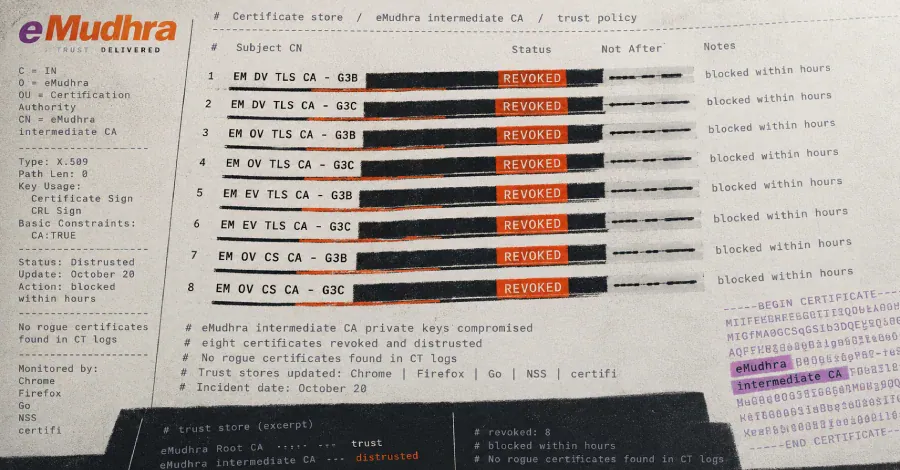
Indian certificate authority eMudhra has had eight of its emSign intermediate certificates blocked by Chrome, Firefox, Apple and Microsoft after a researcher showed their secret keys could be calculated by anyone. One of those keys was literally the number 4. The eMudhra certificate compromise matters because these certificates are what your browser uses to decide whether a website really is who it says it is.
The good news first: browsers moved within hours, and there is no evidence anyone used the keys to attack people. The less good news is that plenty of software outside browsers is still catching up.
A certificate authority is the internet's ID office
When you open your bank's website and see the padlock, your browser has checked a digital certificate. That certificate is signed by a certificate authority (CA), a company that browsers trust to vouch for websites. eMudhra, based in India, is one of them, and sells website certificates under the emSign brand.
CAs usually sign website certificates using "intermediate" certificates, which sit between their main root certificate and your site. Each intermediate has a private key, a secret number that should be a random 384-bit value. That is a number so large nobody could ever guess it. If someone gets that key, they can create a certificate for any website, say your bank or Gmail, and browsers trusting that intermediate would accept it as genuine.
What went wrong: keys you could guess in under a second
According to Mozilla's incident report, as summarised by BleepingComputer, all eight intermediates used P-384 keys generated in April 2025, and every key value was below 256. Testing at most 256 possibilities was enough to find each one.
The Next Web reports that security researcher Scott Helme recovered all eight keys on a laptop in under a second. The keys were 4, 56, 66, 115, 155, 156, 230 and 237. A researcher known as Flüpke published one of them on GitHub as proof: the key for the "EM OV TLS CA - G3C" certificate was 4, and BleepingComputer says it independently checked that this matches a revoked certificate.
eMudhra's explanation, per The Next Web, is that a flaw in its key generation ceremony on 30 April 2025 created a second set of weak keys alongside the proper ones, and the weak ones were the ones published. BleepingComputer adds that eMudhra blamed a script error, and that the weak keys got picked because their labels looked like the real ones.
Timeline of the emSign certificate block
- 30 April 2025: eMudhra generates the eight intermediate certificates with weak keys.
- 17 October 2026, 18:05 UTC: A researcher credited only as Wayne reports the problem to browser root programs. As proof, Wayne signed the message "We have a problem here - Wayne" with each key.
- 17 October, 19:45 UTC: Chrome confirms it and blocks the six intermediates that could issue website certificates. Mozilla finishes pushing a Firefox block at 22:59 UTC.
- 19 October: Apple blocks the certificates. Android gets the block via Google Play Services.
- 20 October: Microsoft blocks them. Mozilla removes the emSign ECC Root CA - G3 root from its trust list and ships Firefox 158.0.1.
- 27 October (expected): Chrome removes the emSign ECC Root CA - G3 root, reaching all devices on the morning of Tuesday 27 October, US Pacific time, per Google's security blog.
If you see "six" in some reports and "eight" in others, both are right: eight intermediates were compromised, and Chrome counts the six that were allowed to issue website (TLS) certificates.
Are you safe? On a normal browser, yes
If you use Chrome, Firefox, Safari or Edge on a phone or laptop, you are protected already. The blocks went out quietly in the background, with no update or restart needed. On Android, Google says restarting your phone pulls the fix immediately if it hasn't arrived.
Google also says no website certificates from these intermediates were ever recorded in Certificate Transparency logs, public records that Chrome requires every certificate to appear in. So no fake certificate from them could have fooled Chrome. eMudhra says most of the intermediates were never used in production and it found no evidence they issued certificates to end users. Attackers could in theory have found the keys any time since April 2025, but nobody has reported evidence of that.
An attack would also need someone to intercept your traffic, for example on a dodgy Wi-Fi network. The Next Web, citing Ars Technica, says Signal, WhatsApp and WireGuard are not affected because they don't depend on these certificates to keep messages private.
For Indian users specifically, eMudhra says its digital signature and eSign businesses in India run on separate infrastructure and are unaffected. It also says its infrastructure was not breached and no data was leaked.
The real risk is in apps and gadgets that never check
Lots of software keeps its own list of trusted certificates and never checks revocation lists, the "do not trust" lists browsers use. Until that software is updated, it may still trust the bad intermediates. Mozilla engineer Dennis Jackson runs a tracking page listing affected software and fixes.
Patches are out for Go (versions 1.27.3 and 1.26.10), Python's certifi, pip, uv, Electron, and the ca-certificates packages in Ubuntu, Debian, Fedora, Arch and Alpine, per The Next Web. Node.js, Bun and FreeBSD were still listed as pending. Jackson also warned that the built-in curl tool on macOS may keep trusting the certificates. Cryptographer Filippo Valsorda, quoted by The Next Web, warned the cleanup could reach IoT devices, Docker containers and unmaintained tools.
What emSign customers should do before 27 October
When Chrome drops the emSign ECC Root CA - G3 root, some perfectly legitimate websites using certificates from that root will start showing errors in Chrome. Google's advice is blunt: site owners on that root should get and install a new certificate from a different trusted provider straight away.
- Check your site's certificate chain. If it leads to emSign ECC Root CA - G3, you are affected.
- Contact eMudhra, which says it is issuing replacement certificates and helping customers migrate, or switch to another CA trusted by Chrome.
- Install the new certificate before the morning of 27 October (US Pacific time), then test your site in Chrome.
Worth watching next: Google says it is reviewing whether eMudhra's other certificates should stay trusted in Chrome at all, with updates to come on public forums like the CCADB mailing list. If you buy certificates from eMudhra for any site, keep an eye on that decision.
Sources
- Google Security Blog: Protecting Chrome and Android users from compromised eMudhra intermediate CA certificates
- We have a problem: eMudhra intermediate key compromise (Dennis Jackson)
- BleepingComputer: Mozilla, Google, Apple block compromised eMudhra CA certificates
- The Next Web: eMudhra certificates had weak keys, browsers block them
Found this useful? Send it to someone who should read it.